Search This Blog

Popular Posts

Labels

Showing posts with label Commonwealth. Show all posts

Tuesday, May 9, 2023

King, Queen, Country, Commonwealth, UK Carriage and Concert


We could not be in Pall Mall, parked in tents overnight, waiting to see the golden carriage. Nor could we attend the concert in Windsor great park. Wow, it is a great park, as you could see from the stage and crowds.

However, we watched it all on YouTube.

I had seen Kate Perry looking for her seat at the coronation in Westminster Abbey and looked her up. I love the Disney version of her song Roar, which she co-wrote and produced. Clever lady, not just a clear voice and pretty face. A very positive message. American Kate Perry saw her song Roar was the top in several countries, including Israel.

You can watch the BBC showings of the concert in different length extracts. My favourite parts were the illuminations from around the country. Especially the Botanic Gardens in Cambridge, illuminated trees and people riding illuminated bicycles.

I took some pictures to remind which parts to recommend to friends and family who might not want to watch the whole thing. You can spin through, using the slider underneath the video.

Prince William's speech was short and sweet and struck just the right note, praising the King and Queen, also thanking everybody, the performers, and audience worldwide, including the medics and teachers and volunteers who help run the country every day of the year. Choirs included a deaf signing choir. videos on an overhead projection showed people performing in countries around the Commonwealth.


Sunday, May 17, 2020

When travelling physically or speaking online, don't mention the war

Flag of Luxembourg.svg
Luxembourg flag

I heard a diplomatic speech about Luxembourg. A lady promoting her country to us said:
'Luxembourg is called the Gibraltar of the North. At its heart is a fortress. Unfortunately it was overcome and we were invaded in WW2. However, the European Union has brought 60 years of peace and a voice to this small country. Our people speak lots of French and German as well as a local language.'

After hearing this speech, I realised how diplomatic it was. A few hours later I heard a speech about  Gandhi's speech to the salt workers.

File:Mahatma-Gandhi, studio, 1931.jpg
Mahatma Gandhi

Several times the speaker reporting Gandhi's speech said, 'And this is how we got our independence - from the British.'

I was the only British person in the audience, but by the time the speaker had finished I felt most uncomfortable. I felt that the speaker must constantly hear anti-British sentiments, and that British visitors to India would not be welcome. I felt that I should consider deleting any posts recommending trips to India, for fear that British visitors would blame me for misleading them if they met with surly looks, hostility or worse.

Now, there are good reasons for a speaker from India to quote Gandhi. He is widely quoted and revered by many people who are not Indian, in England and worldwide. I often quote Gandhi.

It would be perfectly reasonable and inoffensive to say that his speech moved millions of people, and changed the course of history. The speaker did say the Gandhi advocated non-violence. She could have gone further and said this policy protected both the Indians and the British at that time. She could have pointed out that many ordinary British people then, as now, knew nothing about the salt tax or how it affected the Indians, and when Gandhi visited Brtain he had widespread support amongst the workers in the North of England.

She could have mentioned that now most of the people alive then have passed on, and India is proud to be a member of the Commonwealth.

She could have said that many Indians regard Britain highly or fondly, for leaving some fine historic buildings, the railways, the legal system, the language.

She might have said that mixed in with memories of the struggle for independence, are memories of friendship. She might have admitted that not everybody wanted India partitioned before the partitions, and that after the deaths, Gandhi was killed by an assassin who blamed Gandhi for the loss of life.

And today there is still a strong bond bwetween India and Indians and Britain and British people.

We have a bust honouring Gandhi in London. The British regard India with fondness. The British are high on the list of countries sending tourists to India. Every high street in England has at least one restaurant serving Indian food and curry is often called the national dish, and is voted the favourite dish.

I thought about how, as a travel writer, I went  to the World Travel Market in London. Most of the people whose livelihoods depend on tourism, know their governments have spent enormous amounts of money wooing tourists to see fine buildings and try foreign food and buy ethnic clothes and save for souvenirs.

As diplomats for their country, the tourism representatives are very careful. The organizers may try to keep apart the stands for Israel and the Palestinians, Greece and Turkey, but the sales people on the floor are there to promote their own country, not to risk alienating the organizers or potential customers by mentioning any hint of past conflicts. In fact, some of them try to create two-country trips, with new friends in the same business, across the border, a win-win situation.

But what about the media, the man in the street, and the public speakers.

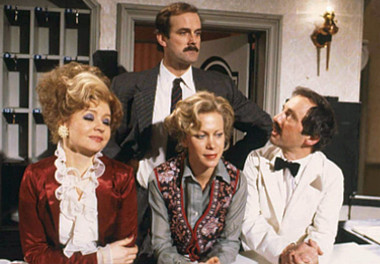
A poular joke goes, 'Don't mention the war!' This is said frequently in the sixth and last episode of Fawlty Towers, where Basil has a series of mishaps which end with the Germans shaking their heads in disbelief, and themselves bringing up the taboo subject by asking, 'How did the British win the war!'

File:Fawlty Towers cast.jpg
Fawlty Towers, TV comedy series

On a serious note, if you are running tours of battlefields.you must mention the war. But if it's a WWII field, you can speak of the Nazis and not the Germans. You can talk about the particular squadron on each side which was involved in a battle. You can leave out any mention of nationality and speak of a particular long-dead battle leader on each side, and his troops.

You can tell the story of the Christmas truce on the battlefields in WWI. You can show pictures of soldiers from both sides shaking hands at Celebrations of Peace, decades later.

What about Asia?

I speak French. I am not French. But I was most uncomfortable going around some of the museums in  Hanoi. Admittedly there was a display in one room about French and American protests against the Vietnam war. At the end was a room about reconciliation. If I had been French, and sensitive, I would have left long before reaching the last room. I wanted to leave. I had to stay because i was with a group including one who wanted to stay.

You can promote the museum on the site of the Burma railway and promote the book about the Burma railway and the Japanese translator who sought to be reconciled after the end of WWII.

A traveller is a diplomat, who should speak well of his own country, and that of his host. When in Rome, do what the Romans do.

I cannot imagine many tourists from the UK visiting Rome and telling Italians that Romans were a bloodthirstly lot and thank goodness the Romans left the UK. No.

Tourists to Italy will talk about what brings them to the country, their love of Italian food, ice cream, espresso, pasta, Roman ruins, learning Latin at school, the influence of Latin on romance languages, opera, favourite Italians from Fellini to Sophia Loren.

Equally, I would expect visitors to the UK to seek to speak about only what they loved and admired about the country and the language.

So, what about Churchill's speech, "We will fight them on the beaches ... we will never surrender."
Churchill statue. Parliament Square. London. England.

It would not be approporiate to say that to a German audience, or an audience which might include Germans. You would have to be very careful to end with words to the effect that we are lucky to live in a world where war is over, the visitors are friends, the Germans on our shores are tourists keen to see our country, and our shopkeepers, mostly born after the war, are keen to welcome the Germans.

You only need to add one sentence, sometimes only one word, to be sure that every person in your audience remains your friend.

Useful Websites
INDIA
https://en.wikipedia.org/wiki/Mahatma_Gandhi

WWII Humour
https://en.wikipedia.org/wiki/The_Germans

Author, Author! About the Author
Angela Lansbury, travel writer and photographer, author and speaker. (Not related to the actress.)
Author of twenty books including: Quick Quotations; Who Said What When.
See books and profiles on Lulu.com and Amazon, such as Wedding Speeches & Toasts. Also watch videos on YouTube.
See other posts on singers and statues and languages and destinations.

Online Toastmasters International Meetings
If you want to learn to speak the Queen's English, or Received Pronunciation. join me at my online toastmasters club,
Braddell Heights Advanced. Wednesdays, 7-9 Singapore time which is seven hours ahead of London, England.

https://www.facebook.com/search/top/?q=braddell%20heights%20advanced%20toastmasters
I am also a member of
Singapore Online.9-12 pm, Singapore time, Fridays. I am also a member of
Tampines Changkat Advanced.
Harrovians, London.
Tiarel.
Toastmasters International Find a Club
https://www.toastmasters.org/find-a-club
https://books.google.com.sg/books?id=upSEBwAAQBAJ&pg=PA21&lpg=PA21&dq=quick+quotations
lulu.com/shop/angela-lansbury/who-said-what-when/paperback/product

Monday, November 4, 2019

Singapore and the Commonwealth - what, when and how does it help us today? Singapore's Succcesses Including Essay Contests


Singapore celebrates its independence, from Britain and Malaya (now Malaysia) but it does, or should, also celebrate being part of the Commonwealth.

Believe it or not the Commonwealth is alive and wealthy. Common, what we have in common, and a wealth of shared history and past, present and future successes and opportunities .


Singapore Flag

Successes
We should all celebrate successes. Singapore is a small dot on the map, but is no stranger to international success and has had success in Olympic swimming and Toastmasters International speaking winner Darren Tay. But when it comes to the Commonwealth the pupils have had great success in essay writing.

The Commonwealth website proudly informs us:
'Singapore has won the annual Commonwealth Essay Competition nine times since 1983 when it was launched; no other country has won more than three times.'

From the point of view of the British expat, Singapore is a good place to holiday or retire, because of its clean safe streets and extensive underground trains running often as fast as every three minutes in peak hours.

Who is in the Commonwealth?
So which other countries, besides Britain, are linked in? Being English speaking is not sufficient. In the Americas, in North America Canada is in, but not the USA.

Several Caribbean islands. the jolly music loving Jamaics and Trinidadians amongst several islands.

Over in Europe, the UK, Malta and Cyprus.

The Australian area, not just Australia and and New Zealand but Papua New Guinea, and couple of islands starting with S and more.

In Asia a lot. India, Pakistan and Bangladesh and Sri Lanka. Singapore, Malaysia and Brunei.
Check up the lists.

Useful Websites
For more information about the commonwealth member countries:
https://thecommonwealth.org/our-member-countries/singapore

To visit Singapore
Award winning Singapore Airlines
singaporeair.com

At Changi airport, walk around to the Jewel mall to see the multi-storey waterfall. If you are airside you can see the Butterfly garden on two levels. Start at the top and walk down.

About the Author
Angela Lansbury, travel writer and photographer author and speaker. Please share links to your favourite posts.


Sunday, December 31, 2017

Who Celebrates Christmas In January? Where? Why?

Merry Christmas with green tabletop tree. Photo by Angela Lansbury. Copyright.

Problem
I have trouble remember which calendar and which countries celebrate in January and whether it's the 6th or 5th or 7th. Please explain - and make it easy to remember.

Answers
Julius Caesar landed in the UK BC. (Never mind accuracy and controversy - we just want the general easy to remember view.)

From him we get our first calendar, the Julian calendar. Julius Caesar, lived before Jesus. His month, July, occurs before Christmas.

Eventually the seasons got out of sync with the calendar.

Later, long after Jesus, along comes Christianity to the Romans, and a Christian Pope, Pope Gregory, who suggest a new calendar (in around 1582 - but no need to remember when).

If you stuck with the old calendar, events are later. The date of Jesus' birth falls in January.

Different countries were faster or slower to adopted the new, Gregorian calendar which we all follow. Many of the traditional, Orthodox, countries kept the old calendar for Christian festivals (just like Jews and Moslems use a different, lunar calendar so the festivals are on different dates each year).

Who celebrates Christmas eve on December 24th and Christmas Day on December 25th?

UK (and former British Empire - now Commonwealth, including New Zealand, Singapore, South Africa, Czech Republic.)
USA

January 7th
Russiand and adjacent Ukraine.
In alphabetical order:
Belarus, Egypt, Ehtiopia, Georgia, Kazakstan, Macedonia, Moldova, Montenegro, Serbia.

Author
Angela Lansbury, travel writer and photographer, author and speaker.

Wednesday, December 28, 2016

Russian and Russians in the Czech Republic


ProblemS
Why are there so many Russian dolls in the shop windows in the old town of Prague? Is it because Russia is nearby?

Answer
Just ask a local person and all will be revealed.

Story
Over lunch a Czech friend told me:

"I learned Russian at school. We had to, in the Russian and Communist era. I wanted to learn another language but I had to do Russian as well, right through secondary school and university. I nearly failed my University degree because I could not pass the Tussian exams. The teachers were all Russians, so you had to get it right, no leeway. Eventually, thank goodness, I made it.

"At first Russian seems very easy. It follows rules but there aren't many rules. However, there are exceptions to the rules. Ans exceptions to the exceptions. After you've learned one lot of exceptions, you find another lot of exceptions.

"I still can't speak Russian fluently or well. I've forgotten it. I'm not confident. I can read it. And understand it.

"But this proved an advantage in business. I went to Russian and the people I was dealing with could see I could hardly say a word in Russian. So they assumed I could not understand anything. But I could understand everything they were saying. So when they were discussing a business deal they voiced their opinions and strategy clearly in front of me. That worked to my advantage."

I asked, "Is Russian still useful to you in daily life? Are there lots of Russians here? I've seen Russian dolls in the shops in the old town. Is that to sell to the Russians? Or because it's cheap to buy Russian dolls?"

"It's not because of the shops' customers. It's because of the shops' owners. The Russian dolls are in the shops because the shops are owned by Russians. After the Communist regime ended, the Russians bought up property very cheaply in the Old Town. Many Russians were business minded. The leaders were managing big companies for the state and could see that when it was privatised they could be making money for themselves.

"The children of the rich were used to the idea of having money and running businesses. So the movement for the end of Communism came from within. The next generation, the children of the former leaders, thought they would benefit.

"The Czechs also thought they would gain. The people who had had land or property or shops before WWII, they saw they would get their old property back. So everybody was very happy and enthusiastic and supported the change."

I now look at the Russian dolls with new eyes, new insight. Not just craftsmanship, and geography, but business and history unfold before me. The little dolls are silent witnesses, symbols. of the Russian influence.

My friend continues, "The Russians like to visit the Czech Republic. We were 'a former colony' if you like. So they feel at home."

Ah, like the Brits visiting America, Australia and South Africa, the Commonwealth countries. They speak our language, English, and share our history which we learned at school.

Now you know why the signs outside the restaurants in the Czech Republic are in English, French, German, Spanish, Italian and Russian.

I sigh, "So Russian is a challenge. I have started learning Russian on Duolingo. The internet is really good for starting new languages, for free."

He smiles, "Yes, it's amazing. You can translate anything into any language. I even did business in China, holding conversation without speaking a word, just typing in Czech and showing the Chinese the translation. We managed quite well."

For the traveller, and the linguist, and the non-linguist, we are living in the golden era.

Tips
Use Duolingo to learn languages for free.

Author
Angela Lansbury, travel writer and photographer, author and speaker. Teacher and tutor of English, languages and public speaking.
Follow me on Facebook. Link to me on LinkedIn. I am also on Twitter and Instagram. See me perform poetry and speeches and give guides to spelling and grammar on YouTUbe.
See more posts and other blogs. Please like and share.