Search This Blog

Popular Posts

Labels

Showing posts with label WWII. Show all posts

Tuesday, May 26, 2020

How to censor online speeches, such as Patton's WWII speeches


My mentee wrote to everyone in an online toastmasters group asking whether there were any taboos regarding language used in speeches. he wanted to quote from the famous, some would say infamous, speeches by Patton in WWII.


The memorable and important gist of the opening of one of his series of speeches is that you do not win a war by dying for your country, but by making sure the soldiers on the other side die for their country.


I read the speech in Wikipedia. Apparently Patton was famous for his down to earth language. However, many of the speeches were reconstructed by combining the accounts of various soldiers who wrote them down afterwards.

Even if Patton used particular swearwords of indelicate terms or ideas, what is apporpriate for a lot of soldiers may not be suitable if it can be heard by a woman with a child on her lap.

Imagine that you are giving the speech to a primary school. Or that your speech is being broadcast in 50 living rooms - which is likely on Zoom with everybody on lockdown.

You can see spouses and children wandering in and out.

As a speechwriter, you should be able to eliminate a word or phrase or find a substitute.

When I was a sub-editor on Woman magazine, I would have had to reword the speech, or abbreviate it, of cut out specific words.

I later wrote articles on WW2 for a Marshall Cavendish partwork encyclopaedia. A partwork is an encyclopedia published in parts, weekly magzines which can be collected and collated in a binder to form an enclopaedia.

The one I worked on longest was translated from an English encyclopadia in English into German and simplified from an adult magazine into one for a reading age of teens from 10 to 16, and had to be understood by those of the youngest age.


Since the articles were from pieces written for an English audience, but now to be read by a German audience, you can imagine that the wording as well as the viewpoint had to be entirely different. Changing the wording was a challenge.

Allies, enemies, and so on - are seen differently and named differently. It was a challenge. But I had to do it. I did it. So I know it can be done.

Useful Websites

Facebook polyglots
https://www.facebook.com/groups/polygotcommunity/
translate google


About the Author
Angela Lansbury, travel writer and photographer, author and speaker.
I and my family have lived in the UK, Spain, the USA and Singapore. I am a trave writer and phtographer and teacher of English A level and English as a foreign language.

Please come to a Toastmasters International Club where the English clubs have a langauge evaluator or grammarian.  We also have French, German, Mandarin Chinese, Tamil and clubs based in Singapore and many more online around the world which because of Covid-19 are now meeting online.

I am President of Braddell Heights Advanced, meeting every Wednesday, on zoom the first Wednesday of the month but the other wednesdays are workshops on app learncool.sg
Or quicker, tinyurl.com/BHACOOL
In Singapore we are on the same time zone as Malaysia, Hong Kong, and China (Beijing and Shanghai).
Please share links to your favourite posts.

Sunday, May 17, 2020

When travelling physically or speaking online, don't mention the war

Flag of Luxembourg.svg
Luxembourg flag

I heard a diplomatic speech about Luxembourg. A lady promoting her country to us said:
'Luxembourg is called the Gibraltar of the North. At its heart is a fortress. Unfortunately it was overcome and we were invaded in WW2. However, the European Union has brought 60 years of peace and a voice to this small country. Our people speak lots of French and German as well as a local language.'

After hearing this speech, I realised how diplomatic it was. A few hours later I heard a speech about  Gandhi's speech to the salt workers.

File:Mahatma-Gandhi, studio, 1931.jpg
Mahatma Gandhi

Several times the speaker reporting Gandhi's speech said, 'And this is how we got our independence - from the British.'

I was the only British person in the audience, but by the time the speaker had finished I felt most uncomfortable. I felt that the speaker must constantly hear anti-British sentiments, and that British visitors to India would not be welcome. I felt that I should consider deleting any posts recommending trips to India, for fear that British visitors would blame me for misleading them if they met with surly looks, hostility or worse.

Now, there are good reasons for a speaker from India to quote Gandhi. He is widely quoted and revered by many people who are not Indian, in England and worldwide. I often quote Gandhi.

It would be perfectly reasonable and inoffensive to say that his speech moved millions of people, and changed the course of history. The speaker did say the Gandhi advocated non-violence. She could have gone further and said this policy protected both the Indians and the British at that time. She could have pointed out that many ordinary British people then, as now, knew nothing about the salt tax or how it affected the Indians, and when Gandhi visited Brtain he had widespread support amongst the workers in the North of England.

She could have mentioned that now most of the people alive then have passed on, and India is proud to be a member of the Commonwealth.

She could have said that many Indians regard Britain highly or fondly, for leaving some fine historic buildings, the railways, the legal system, the language.

She might have said that mixed in with memories of the struggle for independence, are memories of friendship. She might have admitted that not everybody wanted India partitioned before the partitions, and that after the deaths, Gandhi was killed by an assassin who blamed Gandhi for the loss of life.

And today there is still a strong bond bwetween India and Indians and Britain and British people.

We have a bust honouring Gandhi in London. The British regard India with fondness. The British are high on the list of countries sending tourists to India. Every high street in England has at least one restaurant serving Indian food and curry is often called the national dish, and is voted the favourite dish.

I thought about how, as a travel writer, I went  to the World Travel Market in London. Most of the people whose livelihoods depend on tourism, know their governments have spent enormous amounts of money wooing tourists to see fine buildings and try foreign food and buy ethnic clothes and save for souvenirs.

As diplomats for their country, the tourism representatives are very careful. The organizers may try to keep apart the stands for Israel and the Palestinians, Greece and Turkey, but the sales people on the floor are there to promote their own country, not to risk alienating the organizers or potential customers by mentioning any hint of past conflicts. In fact, some of them try to create two-country trips, with new friends in the same business, across the border, a win-win situation.

But what about the media, the man in the street, and the public speakers.

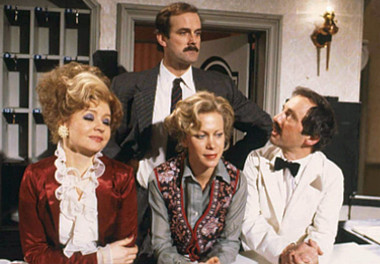
A poular joke goes, 'Don't mention the war!' This is said frequently in the sixth and last episode of Fawlty Towers, where Basil has a series of mishaps which end with the Germans shaking their heads in disbelief, and themselves bringing up the taboo subject by asking, 'How did the British win the war!'

File:Fawlty Towers cast.jpg
Fawlty Towers, TV comedy series

On a serious note, if you are running tours of battlefields.you must mention the war. But if it's a WWII field, you can speak of the Nazis and not the Germans. You can talk about the particular squadron on each side which was involved in a battle. You can leave out any mention of nationality and speak of a particular long-dead battle leader on each side, and his troops.

You can tell the story of the Christmas truce on the battlefields in WWI. You can show pictures of soldiers from both sides shaking hands at Celebrations of Peace, decades later.

What about Asia?

I speak French. I am not French. But I was most uncomfortable going around some of the museums in  Hanoi. Admittedly there was a display in one room about French and American protests against the Vietnam war. At the end was a room about reconciliation. If I had been French, and sensitive, I would have left long before reaching the last room. I wanted to leave. I had to stay because i was with a group including one who wanted to stay.

You can promote the museum on the site of the Burma railway and promote the book about the Burma railway and the Japanese translator who sought to be reconciled after the end of WWII.

A traveller is a diplomat, who should speak well of his own country, and that of his host. When in Rome, do what the Romans do.

I cannot imagine many tourists from the UK visiting Rome and telling Italians that Romans were a bloodthirstly lot and thank goodness the Romans left the UK. No.

Tourists to Italy will talk about what brings them to the country, their love of Italian food, ice cream, espresso, pasta, Roman ruins, learning Latin at school, the influence of Latin on romance languages, opera, favourite Italians from Fellini to Sophia Loren.

Equally, I would expect visitors to the UK to seek to speak about only what they loved and admired about the country and the language.

So, what about Churchill's speech, "We will fight them on the beaches ... we will never surrender."
Churchill statue. Parliament Square. London. England.

It would not be approporiate to say that to a German audience, or an audience which might include Germans. You would have to be very careful to end with words to the effect that we are lucky to live in a world where war is over, the visitors are friends, the Germans on our shores are tourists keen to see our country, and our shopkeepers, mostly born after the war, are keen to welcome the Germans.

You only need to add one sentence, sometimes only one word, to be sure that every person in your audience remains your friend.

Useful Websites
INDIA
https://en.wikipedia.org/wiki/Mahatma_Gandhi

WWII Humour
https://en.wikipedia.org/wiki/The_Germans

Author, Author! About the Author
Angela Lansbury, travel writer and photographer, author and speaker. (Not related to the actress.)
Author of twenty books including: Quick Quotations; Who Said What When.
See books and profiles on Lulu.com and Amazon, such as Wedding Speeches & Toasts. Also watch videos on YouTube.
See other posts on singers and statues and languages and destinations.

Online Toastmasters International Meetings
If you want to learn to speak the Queen's English, or Received Pronunciation. join me at my online toastmasters club,
Braddell Heights Advanced. Wednesdays, 7-9 Singapore time which is seven hours ahead of London, England.

https://www.facebook.com/search/top/?q=braddell%20heights%20advanced%20toastmasters
I am also a member of
Singapore Online.9-12 pm, Singapore time, Fridays. I am also a member of
Tampines Changkat Advanced.
Harrovians, London.
Tiarel.
Toastmasters International Find a Club
https://www.toastmasters.org/find-a-club
https://books.google.com.sg/books?id=upSEBwAAQBAJ&pg=PA21&lpg=PA21&dq=quick+quotations
lulu.com/shop/angela-lansbury/who-said-what-when/paperback/product

Sunday, February 23, 2020

Memories Of A Retired Welsh Farmer: Her Two Husbands, Crochet and Sheep Farming In Wales

 another writer, widowed 'Ann', entertained me over dinner in with stories of her extraordinary life, full of surprises. She started with the story of her wonderful marriage to her second husband, who she met when he taught her to drive. Driving instructors have to be patient people. Her second marriage was the happy ending to her life. (She has severe health problems, like many at the Writers' Holiday, but beams with happiness.) I had seen her around for year.

But I shall tell you her whole life story in chronological order, starting with her childhood dramas. being sent to a home in WWII during wartime evacuation. She had been living with her father and baby brother when she was a toddler, because her parents were separated early on, because her mother had taken up with another man. Then her father was sent to the war, and in case he did not survive, he sent the small children back from the children's home to their mother who had left her husband. Anne's mother was glad to have two extra ration books because her new man was an illegal Irish immigrant with no ration book for receiving rationed food.

Because of the shortage of food, Ann was so thin that people thought she was half her age.

Ann lived permanently with her mother. Anne's stepfather from Ireland was an illegal immigrant. When people knocked on the door and asked for him by name, Anne was told to say, 'He doesn't live here any more.'

Ann'e mother was glamorous, wore high heels and lipstick and went dancing. Everybody thought she was a lively spark. But at home things were different. She had a fearsome temper. She hit Ann on the head with a shovel. Ann lay in bed bleeding for days. Her mother would not take her to hospital, although she could easily have claimed it was an accident and Ann would have agreed. The mother was afraid of losing the child, the child being taken away, and losing the vital ration books.

Later in Anne's life she married. After having three children, she  quit the marriage. She had wanted to take driving lessons and booked a few.  Her husband did not want her to have driving lessons. Anne took driving lessons. Mid-way, her husband said he was not paying for any more lessons.

When Anne told her driving instructor she was leaving her marital home, he said, "If you are leaving home, I am coming with you." He became her second husband and they were happily married for many years until he died.

He had been married, too. But his wife was not bothered when he left. He did her a favour. She was Catholic and didn't not consider their marriage, which had not been in a Catholic church, to be a proper marriage. Shortly after the divorce she married a Catholic in church, and she dressed in white.

After dinner, Ann told me she used to crochet.

I asked, "With wool?"

'Yes, wool from my sheep."

This sounded bizarre to me, brought up in London. For a woman with sheep in Wales it was pretty normal.

After being widowed, Anne moved to Wales and bought a farm but had no animals. She started with no sheep but local people, local farmers, in her first year, took pity on her and gave her bottle lambs, who were abandoned by their mothers and had to be bottle fed.

What kind of sheep abandons the baby? Possibly one which has given birth early in the mother's life, a young mother. Hm. Interesting. Does this have implications for human beings?

Anne had seven baby lambs the first year. After a year they can have one to two or three babies. Not in succession. simultaneously. Some even gave birth to quads.

In three or four years she had about 70 sheep.

Sheep would get out through the fences. Other farmers would come to collect their strayed sheep.
They would say, 'I'll send in my dog to cut out my sheep." Cut out meant to round up and lead out.

The farmers could recognize their sheep by the marking. The dog would recognize the sheep by the smell.

I asked former farmer, Anne, "Do you eat meat, such as lamb?"

She replied, "I prefer mutton. More flavour."

Anne is now retired and her children tell her, "You should write your life story." I think she should, don't you?

Saturday, January 25, 2020

What I learned from visiting Auschwitz in Poland, And About Anne Frank


Flag of Poland. White above red.

Not to be confused with  the flags of Singapore and Indonesia.

Flag of Singapore. Red above white. Has the crescent, a reminder that Singapore was once part of Malaysia.

Plain red above white.
Flag of Indonesia.

The first thing a Polish guide will want to tell you is that Auschwitz may be on Polish soil but it was not run by the Poles.


It was run by the NAZI party of German when Poland was occupied by Germany in WWII.


Auschwitz is the German name for the small Polish village on the outskirts of Krakow. Quaint, historic Krakow, the former Krakow, is a pretty little town, the former capital in the south of Poland. The Germans invaded and could easily capture the small city near their border, quicker and easier than capturing the larger city of Warsaw further away. That's the reason why over-run Krakow was preserved by the Nazis, whilst Warsaw was destroyed in the war.

Auschwitz, the camp, was outside the new German HQ in Poland, and less time and effort to transport the prisoners there.

I put off visiting Poland and Auschwitz for years because I thought it would be too upsetting. I was right.

One of the things I learned, was they showed a couple of photos of people taken on the day they arrived and three months later. The reason for the numbers tattooed onto inmate's arms was that people's faces were so thin, and lined and haggard, so different, that after 3 months you could no longer recognize them from their original identity photo.


Anne Frank

Anne Frank, her sister, Margot and mother and father were in Auschwitz.

Children under the age of 15 were killed on arrival. Anne was 15 so she survived the first selection, and was set to work, like the rest of the family. The mother died there, giving her meagre rations to her two daughters.

Anne and her sister survived Auschwitz and were sent to Bergen Belsen in German when the Germans retreated. Anne and Margot died in Bergen Belsen.

Their father survived. He later married a woman who had lost her spouse and offspring in the war. They had met regularly in the weeks after the end of WWII searching, for news of their families at the centre giving news of people found dead and alive.

Anne Frank's father moved from The Netherlands to Switzerland and his stepdaughter to London, England. She and her husband lived in Edgware where I grew up. I did not know that until after he died. The family kept a low profile.

Why no mention of Anne Frank in Auschwitz? Because the authorities do not want to single out one person but tell the stories of all. Because Anne Frank's possessions are elsewhere, in the Netherlands. She is already well documented in her WWII hiding place, now a museum in Amsterdam, Holland, The Netherlands; in Frankfurt, Germany, in the Jewish museum; and in the USA Anne Frank Centre.

Birkenau Birkenau I was advised that to understand what happened at Auschwitz you must visit Birkenau, just down the road. Yes, you must. In the first museum its is like a house of horrors boarding school.

Birkenau is totally different. fields. Huge hangars. Going on for miles.

This huge hangar in a field surrounded by barbed wire was for the French. The next huge hangar in the next field was for the Dutch. The next huge hangar for the italians. Stretching as far as you can see. All destined for death.

Stretching as far as you can see for all the nationalities and languages. Into the distance. Suddenly you understand this was not just cruelty to this person and that, but to hundreds, thousands. The trains brought them from all over Europe. Suddenly the map of the railway routes, which I had seen on the outskirts of Munich, at Dachau, were not just a plan of railway lines, but a horror of wiping out people in every country of Europe, an entire continent.

Belsen Anne's family had left Germany to live in Holland. Finally, those who survived Auschwitz, returned to Germany, to die in Belsen.


Saviour Schindler Let's end on a lighter note. The museum in Krakow in the factory connected with Schindler tells about those he saved. Every story is of gratitude, to the saviour, Schindler. A person who survived. In a sea or sorrow, one beacon of light, a lifeboat.

Poland's Trails Also in Poland, see the Jewish museum in Warsaw and do a Jewish tour. Visit Bialystock and learn about Zamenhof and his new language of Esperanto.

More trails tell you about Chopin and Copernicus.

Places to visit
Anne Frank house, Amsterdam, Netherlands
Auschwitz, Poland
Bergen Belsen, Germany
Anne Frank Foundation, USA


Anne Frank House, Amsterdam, Holland, The Netherlands


Statue of Anne Frank in Amsterdam, The Netherlands


Anne Frank Center USA

Useful Websites

Poland
https://www.pot.gov.pl/en/information-about-the-polish-tourism-organisation/polish-tourism-organisation-international-offices
https://poland.pl/tourism/
Krakow
https://www.visitacity.com/en/krakow
https://www.muzeumkrakowa.pl/branches/oskar-schindlers-factory
Auschwitz
https://www.viator.com/Krakow-tourism/d Anne Frank
https://artsandculture.google.com/exhibit/CAICnOLtC0lDLg?

About The Author
Angela Lansbury, travel writer and photographer, author and speaker.
See later post about Auschwitz
Please share this link and links to your favourite posts.


Wednesday, January 22, 2020

Have You Booked Your Holiday? How To beat Procrastination And Setbacks And Keep Smiling


I have a dream, a dream destination for a holiday. Have you booked your holiday?

As soon as I hear the other person's answer, I can start surmising the whole life of the person who replies.

'Yes, I booked it last week.'
Judger. (Myers Briggs personality typing.) He or she will arrive early.


Another type will reply: 'Not yet.'

I ask: 'Why not?'


The answer: 'Still looking around.'

ADVANCE PLANNING
You can plan your year ahead. My family did this for a wedding and honeymoon. When is the wedding? June. Which countries have good weather in those months?
Read about destination in Wikipedia, Wikivoyage and Wikitravel.


Pay by credit card of a means which allows you to recover if the company goes bust.
Make a list of places to see.

Safety and Insurance
Check safety warnings on Wikivoyage, UK Foreign Office, and US state advisory. Check insurance. If government warnings are in place probably your insurance won't cover you. Also your company will advise you not to go or will not fund the business trip.


Make a list
Check passport (s). Visas.
Check flights.
check weather.
Check hotel prices.
Check activities.
Book first and last night events.
Know alternative exits if you have to leave suddenly lose your flight.
Check insurance exclusions.

Driving License
Take copies of driving licenses even if you do not intend to drive. Why? If another driver is too young or old or does not have an international license you might need documentation.

If your driver is to drunk, tired or ill you might want to share driving. If your driver is held by a hospital or police you might need to drive. If the chauffeur driven car is not available and you are offered self-drive this could be a better option than a bus when you are racing for a flight.

PROCRASTINATION Procrastinator. He or she will book late. And arrive late. Forget to check dates. Lose their passport. Miss the meeting.

JUDGERS & DECISION MAKERS Judgers like to take decisions. Clear the desk. Do tasks in order. Make a list. Work through the list. Don't interrupt me.

That's my husband.!

I wish I could be like him. I am trying.

TRY

Oops. I gave myself away with that sentence.

I've heard trainers say, 'Don't try to do it. Do it!'

If at first you don't succeed, try, try again.

Churchill walking through the ruins of Coventry Cathedral in 1941.

Never, ever, ever give up.
Winston Churchill WWII 1939-1945

Find an ally to give you physical and mental encouragement.


Churchill and Roosevelt. Statue in Bond Street, London, England.

Find an ally.

Six years of war. Better than the hundred years war!

Finally - the war is over.


My parents lived through two world wars, born during the first word war, lived through the second world war. My mother lost her first husband. She married again, to my father, and had me. I asked my father, 'Did anything good come out of the second world war?'

He replied, 'Yes. Me!'

SETBACKS
What's beyond? You don't know.


Make a list.

Too many choices.


When I tell my husband, 'I have a problem,' he replies: 'It is not a problem. it is a task.'

Let's look at the sayings which can encourage you to change or proceed with your plans, to face setbacks, to share success.

OPEN DOORS
Closed And Open Doors One door closes, another door opens.

I put up a positive statement about a door on Facebook. 'If a door shuts, open it again. It's a door. That's now they work.'

Somebody replied, What if ... what if... what if ...

I replied:
True. But the whole point of an aphorism is to lift people who are easily swayed by a single sentence. Just give them something to hang onto.

Like showing a balloon or a musical mobile to distract a crying child.


ENFP - MYERS BRIGGS PERSONALITY TYPE If you are ENFP on Myers Briggs you are dwelling on the past and future and doubts. The purpose of the aphorism is to add a weight to the positive side of the see-saw to restore balance.

The encouragement gets you going. Gives you a boost.

If you have already started and you stop halfway, the encouraging word or idea or saying sustains you. Like chocolate for mountain climbers.

Yes, chocolate is bad for the teeth in the long run. Also the lift feeling wears off. But it gets you going

Similarly, I eat a chocolate biscuit or cake or a chocolate bar in the break before going speak on stage at a Toastmasters or other meeting. The sugar and caffeine lifts you up - only for 15 minutes, But I find that boost and time is enough to get me bouncing onto stage and beaming. (I also use wearing a red colour, making a noise to get attention wakes the audience and myself, interacting with the audience wakes them and keeps me alert.)

What about sharing the success, affecting their life, making a call to action, or using the written or spoken text to promote your message? End with a message.

The person who wrote to me on Facebook ended with a promotion. I replied and took their cue to end with a promotion: I wrote: This post is promoted by Braddell Heights Advanced Speakers in Singapore. Next meeting in 2020 is Wed Feb 5 evening 7 pm at BH CC and next Speechcraft Saturday afternoon Feb 15 at 2 pm.

What to say to yourself when you are travelling and waiting, or suffer a temporary setback.
Here are some positive sayings in English

TO GET STARTED
Procrastinators are other people. Procrastination is what you used to do. Positive action is what you are starting to take now.
Angela Lansbury

To beat indecision and self-doubt:
You have to be in it to win it

You don't have to see the whole staircase to start climbing.
Martin Luther King Jnr


Do It Now.
Just do it.
Nike.

A journey begins with a single step.
Attributed to Confucius (and others).


AT THE DESTINATION
Always have a plan B. I have arrived in a city for a long weekend and all the restaurants and shops and museums were closed on Monday.

AFTER SEEING A SETBACK, TO PROCEED POSITIVELY
You don't plan to fail. You fail to plan. Start your plan. Plan your next hour, day, week, month, year, 5 years, whole life goals.
One door closes, another door opens.


TO PROCEED WHEN TIRED
Keep right on to the end of the road ... (WWI song)

TO ASK FOR HELP
If you don't want to burden your family and friends and teachers and colleagues, ask a stranger.

If you don't want to risk involvement with a stranger, who might follow you, and ask for money, ask an official who is anchored to the help desk at the airport for a map with a list of restaurants.

Check out a restaurant list before you go, using the internet. Print it and put it in your pocket.

To save paper, keep it in your mobile phone. In case you lose your phone or use a different one, email yourself and pick up the email later on a new phone.

If you don't want to use a phone in a public place, write a blog post and ask a hotel concierge or friendly official to log into the website, read the suggestions, and draw the location on the hotel map. Then you will see how to get to the nearest good restaurant, and equally importantly, how to get back to your hotel.

If you are in a country or destination such as Hong Kong, where taxi drivers do not speak English, ask your hotel concierge to write the name of the restaurant on the back of the hotel card.

What do you want when you meet somebody else on your journey? To find the way? To the airport or restaurant? To get a recommendation for a restaurant? Or Supermarket? You will need that question written down in the local language. Either start learning the local language. Or write down the most needed words in that language with the translation and keep that piece of paper handy in the right hand pocket of your jacket.

CALL TO ACTION
If not now, THEN WHEN?
If not you, THEN WHO?
If not here, THEN WHERE?

TO SHARE SUCCESS
Laugh and the world laughs with you. Cry and you cry alone.
Nothing succeeds like success.

To encourage others
Call to action.

Travel Inspiration
visitbritain.com
visitlondon.com
Churchill and Roosevelt statue, Bond Street, London, England.

Churchill statue, Parliament Square, London, England.

Coventry Cathedral


Churchill bust. Israel.

Useful Websites
https://www.amazon.com/Essentials-Myers-Briggs-Type-Indicator-Assessment/dp/0470343907
visitbritain.com
wikivoyage
wikitravel
tripadvisor

About the Author
Angela Lansbury, travel writer and photographer, Author and Speaker. Please share your favourite posts


Saturday, August 17, 2019

Drive A Tank at Armourgeddon In England, see a WWII jet plane, and Richard III's tomb


"I'd like to drive a tank," enthused my husband, when I told him that an attraction in England offers you a chance to drive a tank.

What a great idea for a birthday for the boys, or men, or the whole family. I have no desire to drive a tank. But I can instantly see or imagine their excitement and get vicarious satisfaction. I picked up the leaflet on tanks at the motorway stop near Leicester. Years ago Leicester was not on the tourist map. Just a name. Then I had stopped to visit a good friend, but did not bother diverting to see the cathedral. I was far more excited learning from her husband that when you stand on stage, you engage the audience by opening your arms wide.

In those days I would have been bored by the idea of a tank and acting out a WWII scene. Paintballs, I thought, were games for toddlers and men who have not grown up. But this time somehow my perception of Leicester was different. What was lurking at the back of my mind? Richard III? I knew Leicester and it was a place with modern activity, ancient activity, the ghosts of the past come alive.

Let's start with the leaflet on tanks which helped England fight and win wars, win battles, engaging ordinary soldiers. Later we shall come back to VIP-not-to-be Richard III losing his battle with an older form of battlefield transport for advance, attack, and escape, the horse. When you drive into battle with your horse towering over foot soldiers, or your tank on the horizon, you feel all powerful. If your horse crumples, you are a dead man. The same applies to a tank.

But as a tourist, you are alive, excited, invincible.

Tanks
The tank place is built on an old military range. You start with a ride around the area in a tank driven by an instructor. As I looked at the leaflet, the rain poured down outside. Yes, but what if it rains? If it rains, you won't mind diverting into the museum which contains more than 70 wartime vehicles, all in giant aircraft hangars. You will learn why those hangars were there later.

Ages
If you are over 17 years of age and have a driver's license, you can book to drive one of several vehicles, and play paintball games. Children must be over 8 years old. Some activities are for different minimum ages, including clay pigeon shooting, and archery. No problem if, instead of saying 'we' are going to do such an activity, you say, 'we are going to watch Dad,' or them, 'doing so and so,' or, 'We are going to sit in a tank!' instead of we are going to drive one.

When?
The outdoor activities, the whole place, is open like many UK attractions in the tourist high season, in good weather. April to October. Wednesday to Sunday, 10 am to 4 pm. How do you remember that? By looking at the logic. So the staff are there for you at the weekend, but take off the dead days of Monday and Tuesday. The tanks are out and about in daylight hours, ten to four. Like on a film set, for photographs.

So they won't bother opening in the hope of attracting a random stray visitor in the off season.
However, you can book group activities throughout the year. Where, again? It's near Market Harborough. And Leicester.

Whilst in the area, look out for the aviation monument on a roundabout just south of Lutterworth. That memorial is not just a random piece of decoration. It is an essential part of the story, the history, of the area. The jet engine started here. Engines don't sound romantic. But when you think of Icarus trying to get off the ground, engines are the heart of flying, the power, winning in peace and war. Winning the battle in olden times - and in modern times they are winning the modern battle for tourists' attention.

Wikipedia says of Lutterworth:


Frank Whittle, inventor of the jet engine, developed some of the world's first jet engines at the British Thomson-Houston works in Lutterworth, and in nearby Rugby, during the late 1930s and the 1940s, with his company Power Jets. A replica of his first jet aircraft the Gloster E.28/39 stands in the middle of a roundabout just south of the town as a memorial, and a number of papers and documents relating to Whittle's development of the jet engine are displayed at the town's museum.[7]


Photo from Wikipedia in public domain.

Rugby is famous for the school. The game of Rugby, supposedly started there. Wasn't there a saying about war being won on the playing fields of Rugby, where the upper class boys, the future leaders, practised fighting to win, keeping fit, and playing in a team.

Er, no. I checked. The saying was that the battle of Waterloo was won on the playing frields of Eton. Eton is near Windsor, which you pass driving west from London, on the M4. Leicester is on the road north from London, the M1. Yet somehow the idea of the playing the game on the battlefield persists. The good old days when you fought the oposite team with every ounce of your energy, but, at the end of the game, you shook hands with the enemy if you won, and the losers, with good grace, conceded defeat to the winners and congratulated them on their prowess.

Next, near Leicester and rugby, you can travel further back in time, before tanks and before engines. The big excitement for those studying history and literature was the discovery of the body of Richard III in a Leicester car park. It sounds odd, doesn't it?

But modern excavations unearth all sorts of exciting and interesting relics of the past, weapons, food, skeletons. The first time I heard about Richard III, I thought, Who cares?


The infamous Richard III. Did he or didn't he? Kill the princes? Lose his horse?

A Canadian visitor to a Writers' Summer School at Swanwick was at first baffled by our enthusiasm for Richard III. I must admit, when I first read the newspaper reports about his body, I thought, Richard III? I could not place Richard the first, Richard the second or Richard the third in my memory bank.

But the phrase 'my kingdom for a horse' resonated. In England, people often use that phrase as the base for a comment on something else urgently wanted. Such as, 'my kingdom for a cake', or, 'my kingdom for a cup of coffee'.

It is one of many phrases from Shakespeare's plays which have landed into daily conversation, unnoticed by the average person. Like, 'Oh, woe is me for you are undone'.

The lady from Leicester lit up like a tourist guide when the name of Richard III was mentioned. Our Canadian friend was illuminated by the collective glow as five of us leaned forward and competed to tell the story of Richard, desperate for a horse on the battlefield, as he lost his life, and kingdom.

So, if you visit the Leicester area, stop, or at least stop on the motorway and think about the area and plan a return visit. After thinking of tanks, or instead of 'my kingdom for' a tank, there's 'my kingdom for' a horse. Continue on to Leicester to see the story of King Richard III, last of the Plantaganets, before the throne was taken over by the Tudors, notably Henry VIII, and Elizabeth I.

Remember the Wars of the Roses. One was white and the other was red.


More about Richard III in the next post.

Southfields Farm
Husbands Bosworth,
Lutterworth,
Leicestershire LE17 6NW
Tel: 01858 880239.

Useful Websites
www.armourgeddon.co.uk.
www.militarymuseum.uk.
https://en.wikipedia.org/wiki/Gloster_E.28/39
https://kriii.com Richard III Visitor Centre
https://www.visitleicester.info/good-to-know/visit-leicester-information-centre

About the Author
Angela Lansbury, travel writer and photographer, author and speaker.