Search This Blog

Popular Posts

Labels

Showing posts with label plural. Show all posts

Tuesday, July 15, 2025

Spanish Words You Will Recognize


 Of course you should be learning grammar and whole sentences, not just vocabulary. But anything is better than nothing, and a few rods might get you in the mood for doing more. So, let's go.

Duolingo teaches you Brazilian Spanish.

Translate google gives you the option of Spanish used in Spain and Europe, and Brazilian South American Spanish.

Easy Spanish Words - Months

The names of the months in Spanish are similar to the English words. Translating from Spanish to English is easy. English into Spanish is more difficult, because mostly just one letter is changed. 

The Spanish and Italian languages don't use capitals for the months, which makes typing quicker. 

Spanish - English

abril - April

amigo - friend

bancos - banks

cartas - letters

el - the

el (with an accent on the e) - he

frio - cold

io - I (drop the letter o and you get the English word I)

julio - July

libros - books

Los Angeles - the angels (los is the plural)

mayo - May

mi madre - my mother

mis amigos - my friends (the word my in Spanish is plural here, agreeing with the noun)

Muchas - many

musico - music

necesito - I need

Nueva York - New York

quiero - I want

Quiero aprender español - I want to learn Spanish

si -yes

sopas - soups (add s for the plural in both English and Spanish) 

supermercado - supermarket

y - and


English - Spanish

and - y

april - abril (turn the p upside down mentally to think of the Spanish)

banks - bancos

books - libros

cold - frio

friend - amigo

I - io

July - julio (for the Spanish, drop the y and change it to i, as well as adding o)

(to) learn Spanish aprender espanol

many - muchas

May - mayo (Just add o for the Spanish)

music - musico

my friends - mis amigos

my mother - mi madre

(I) need - necesito

soups - sopas

supermarket - supermercado

the angels - los angeles

they - ellos (looks like el which is he and los which is the pural)

(I) want - quiero

yes - si


Useful Websites

duolingo.com

translate google

https://translate.google.co.uk/

wikivoyage phrasebook Spanish 

Please share links to your favourite posts. I have several most posts on learning Spanish on this blog.

Thursday, October 19, 2023

Quick guide to Indonesian words - mostly the same as Malaysian


Flag of Malaysia, which is almost the same as Indonesian.

Starting Indonesian on Duolingo is easy.

Indonesian - English

air - water (pronounced aye er, as it is written in the Singaporean placename and MRT underground railway station, Telok Ayer)

apple/ apples - apel

dan - and (the same letters in a different order)

jeruk - orang/oranges (juicy oranges, letter er, then UK)

kamu - you (I think of 'come here, you')

makan - eat

minum - drink

punya - possess/have

saya - i/My (remember the letter y in both words)

susu - milk


English - Indonesian

and - dan

apple/apples - apel

drink - minum

eat - makan

I - saya

milk - susu

orange/oranges - jeruk (remember JEruk not juruk, je like the GE in orange)

possess/have - punya

water - air

you - kamu 


False Friends

air meaning water looks like air but it isn't air, it's water, unless you think of H2O

Useful Websites

duolingo.com

Please share links to your favourite posts

Friday, August 3, 2018

See the Giant Puppets At The Sultan Hotel in Jakarta, capital of Indonesia

Jakarta is located in Indonesia

Indonesia map from Wikipedia.


Photos by Trevor Sharot.
 http://trevorsharotphotography.com
..............

Photos from Wikipedia

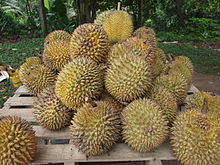
Jakarta's nickname is The Big Durian.
Durian.jpg
Durian is called the king of fruits. The name durian comes from the Indonesian and Malay word for thorn because of the skin.

Durians are for sale in Indonesia. (Also sold in Thailand and Malaysia.) Whilst I cannot eat the strong smelling and slimy durian fruit, I love tasty durian ice cream and durian cake, and white or yellow durian sauce, which reminds me of thick egg custard or egg yolk with the flavour of chestnut.

Author of photo, ProjectManhattan in Wikipedia under Durian.

Durian is available in season in Singapore. but banned in the Singapore MRT (train system) and buses and taxis.

Jakarta's motto is Jaya Raya which is Sanskrit for victorious and great. ( I know several people called Jaya.)

Museum in Jakarta.


Photo from Wikipedia: Gunawan Kartapranata - Own work
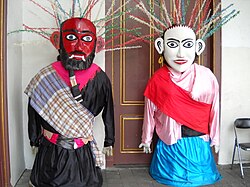
The parade of Ondel-ondel on main street of Jakarta during car-free day.  The Ondel-ondel (a repeated hyphenated word is a plural) was originally a symbol of an ancestor protecting a village from calamity and danced in the street. In modern times the Ondel-ondel is the symbol of Jakarta and dances to entertain in streets on festive occasions, and at weddings and openings of buildings and events.
Watch a pair of them performing in pairs in a street on Youtube. Notice the musicians in the background.


Ondel-ondel puppets in Wayang Museum, Jakarta. Photo author Taman Renyah, in Wikipedia. These puppets appear in pairs, the red face being male and the female with a white face. The head-dress is made from strips of coconut leaves wrapped in coloured paper. The light bamboo body is lifted by a person standing inside who dances, twirling on the spot, or dancing and hopping around the partner.
https://www.youtube.com/watch?v=HT0Vtacah7k The puppets dancing.


Transport in Jakarta. Blue three-wheeler is a taxi.
 Picture from Wikipedia.

Useful Websites:
https://www.indonesia.travel/uk/en/home
Wonderfully engaging website pages with great pictures and helpful captions

http://trevorsharotphotography.com
Some serious photography here. Great subjects, great composition and great colours.

Author
Angela Lansbury, travel writer and photographer, author and speaker.

Thursday, July 12, 2018

A New Way To Learn Malay With Pictures And Speech


In Singapore the undersground railway (MRT) station, Botanic Gardens, is Kebun Bunga in Malay. Kebun is garden; flower (the adjective) comes second. My memory aid, bunga like bulb. The initial letter b of botanic and the initial letter b of bunga are similar. The G of garden and the k or kebun sound similar. Photo by Angela Lansbury. Copyright.

Emergency exit advice in Singapore on train. Photo by Angela Lansbury. Copyright.
Put the words  individually into Translate and this is what they mean.
Pintu - door
keluar - exit
kecemasan - worry

di - in
sebelah - next
hadapan - presence

dan - and
belakang - back
kereta - train
api - fire
However, run the words consecutively and you get the result:
The exit of anxiety before the front and rear of the train

Building works warning sign in English and Malay. Photo by Angela Lansbury. Copyright.

Translation of sign on building works in Singapore  Malay - English
bahaya - danger
jangan - do not
dekat - close (adjective not verb)
Jangan dekat - Do not get close (in other words keep away)

Problem
I am learning to recognize Malay words from signs in Singapore, but not how to hear them.

Answer
I signed up for the free introductory lessons in Malay. The first lesson shows you pictures of man, woman, boy girl, bicycle and ship.

I noticed something I had read earlier on Duolingo, that nouns start with a pre-fix SE. Malay is logical, easy, although sometimes longer.

For example, plurals: two or more boys, instead of remembering the plural, which in English often adds an 's', but could be 'es' as in wishes, or a total change as in wolf and wolves, child, children, in Malay you simply double the word, so anak for child, for children becomes anak-anak.

The modifiers (words which modify or change or add to the information in the noun) go first in English, but second in Malay. (French also has adjectives after nouns. Moulin rouge is red windmill.)

If you translate word by word as you think into another language, the structure come out wrongly. This applies with a translation from a translation device and when you are thinking.

That is why it is good to learn phrases instead of individual words. You get the phrase right. Your brain gets a feeling of where the adjectives and nouns and verbs should be positioned in a sentence in another language.

Malay
Malay can be simple, at other times it looks long and complicated. For boy, you have three words" person (orang), male, small/young. The same for girl, person (orang). Orang as in orang utan. Before you even start learning Malay, you know one word.

Cross the bridge to the border from Singapore to Johor Bahru and you will see more Malay language signs. Or go up to the towers featured in the film.

Malay is one of the four languages in Singapore.

Useful Website
https://l-lingo.com/webapp/#/onboarding?product=mly&referer=https:%2F%2Fl-lingo.com%2Fen%2Flearn-malay

Author
Angela Lansbury, travel writer and phtogapher, author and speaker. If you want a an entertaining and infomative and encouraging talk or workshop on learning Malay and other languages, please contact me. Share links to this post with your friends and colleagues. 

Tuesday, October 3, 2017

Italian Words handy to know when booking holidays and researching events

Problem
Where's the information I want on the Italian website, the dates?

Answers
Most of it can be read if you take it slowly and pick out key words which sound similar to the English. You can copy a vital section into Google Translate, but it has a word limit. Also, when you have several pages, you need to work out which page, if any, is relevant. Here are some words which may help you. I scanned the titles of pages and worked out that what I wanted was eventi, events. Then I wanted to know the prices and what was included.

ITALIAN - ENGLISH
abito - dress or habit (ie dress code)
accessori - accessories
aperitivo - aperitif / starter / welcome drink
atmosfera - atmosphere
artisti - artists (plural)
ballo - ball
benvenito - welcome
c a r n e v a l e - carnival
cena - meal
cioccolata - chocolate
con - with
di /d' / dell - of (the)
discotecca - discotheque
dolci - sweets
durato - duration
e - and
entrata - entry / entrance
epoca - epoch or time period
evento - event (singular)
e v e n t i - events (i is plural, equivalent to the English s)
Febbraio - February
inclusi - included
info - information
internazionali - international
la  - the
Maestro - master
maschere - masked
mille - thousand? / many (not million)
moderno - modern
ore - hour / time
per - for
persona - person
prezzo - price
privati - private
riservati - reserved
sala - room (like the French word salle and our derived word salon and the American salloon)
specili - special
splendido - splendid
storica - historic / period
tariffe - tarif / price
tipici - typical
tutti - all
Venezia - Venice
veneziani (Venetian objects of Venetian style foods or objects)
vini  - wines
voci - voices

ENGLISH - ITALIAN
carnival - c a r n e v a l e
discotheque - discotecca
events - eventi
February - Febbraio
modern - moderno
of - de
person - persona
the - la
Venice - Venezia

Author
Angela Lansbury
See my other posts on Italian language.

Thursday, September 14, 2017

Translating, understanding and learning from German tourist information


Problem
I have been going through my house trying to throw away old papers and objects which are out of date and creating such a clutter that I cannot find the recent stuff. But before throwing anything out, I have to take a look at it. I have a pile of souvenir CDs from travel shows and I am going through them one by one, one a day. Here's is what I found:

I have an old CD-ROM from Sachsen 2000.  I have the text here and a list of German-English and English-German words at the end. I looked at the paragraph and it was a mystery and hard going and I nearly shut my CD and threw away the disc, then I thought, just a minute, put this into Google translate. Here's what I saw. Glance at it and then read on.

Mit dem Leipziger Umland beginnt das “Sächsische Burgen- und Heideland” – eine reizvolle, hügelig schwingende Landschaft, die sich im Norden bis zur Dübener Heide, im Westen bis zur Dahlener Heide und den Elbauenlandschaften erstreckt und im Süden bis in das Erzgebirgsvorland im Chemnitzer Raum reicht. Handwerk und Landwirtschaft haben diese geschichtsträchtige landschaftlich reizvolle Region mit kleinen Städtchen, verschlafenen Dörfern und malerischen alten Schlössern, Burgen und Herrensitzen über Jahrhunderte geprägt.
Dem Besucher bieten sich vielfältige Möglichkeiten – sei es ein zünftiges Rittermahl oder ein kurfürstliches Gelage mit typisch mittelalterlichen Speisen und Flair auf einem der alten Adelssitze im “Tal der Burgen” am Muldenfluß, eine waschechte Floßtour auf der Zschopau, eine Fahrt mit der Schmalspurbahn “Wilder Robert”, Radwandertouren entlang gut markierter Radwanderstrecken an der Mulde und Zschopau, Wanderungen durch ausgedehnte Auenwälder oder entlang wildromantischer Flüsse oder eine Einfahrt in einen ehemaligen Silberstollen…
Zahlreiche alte Städte, wie Colditz, Rochlitz und Waldenburg, laden mit Geschichte und Geschichten zum Erleben in historische und originelle Museen ein. Stimmungsvolle Kloster- und Parkanlagen, z.B. in Altzella bei Nossen oder in Klosterbuch bei Leisnig, lassen eindrucksvoll das Leben der einstigen Zisterzienser-Mönche nachempfinden.

Gotische Dome, typisch sächsische Hallenkirchen mit reicher Innenausstattung und interessante Dorfkirchen markieren Höhepunkte der Baukunst der Region. Musikfreunde erwarten hier Konzerte, bei denen sie sich dem Klangwunder alter und kostbarer Orgeln, u.a. von Gottfried Silbermann, hingeben können. Es ist eine Region der feinen Töne, die ihren Reiz beim genauen Beobachten offenbart.

I have blown up the print size to normal so I and you can refer back to it.
I put it into Google translate and looked at the English. In Google I had the texts side by side   so I could read through each sentence. I read the English first, getting the general gist. Then took each sentence. Finally, I went back and read both again, and noted down the easy, instantly recognized, and the new words.
Mit dem Leipziger Umland beginnt das “Sächsische Burgen- und Heideland” – eine reizvolle, hügelig schwingende Landschaft, die sich im Norden bis zur Dübener Heide, im Westen bis zur Dahlener Heide und den Elbauenlandschaften erstreckt und im Süden bis in das Erzgebirgsvorland im Chemnitzer Raum reicht. Handwerk und Landwirtschaft haben diese geschichtsträchtige landschaftlich reizvolle Region mit kleinen Städtchen, verschlafenen Dörfern und malerischen alten Schlössern, Burgen und Herrensitzen über Jahrhunderte geprägt.
Dem Besucher bieten sich vielfältige Möglichkeiten – sei es ein zünftiges Rittermahl oder ein kurfürstliches Gelage mit typisch mittelalterlichen Speisen und Flair auf einem der alten Adelssitze im “Tal der Burgen” am Muldenfluß, eine waschechte Floßtour auf der Zschopau, eine Fahrt mit der Schmalspurbahn “Wilder Robert”, Radwandertouren entlang gut markierter Radwanderstrecken an der Mulde und Zschopau, Wanderungen durch ausgedehnte Auenwälder oder entlang wildromantischer Flüsse oder eine Einfahrt in einen ehemaligen Silberstollen…
Zahlreiche alte Städte, wie Colditz, Rochlitz und Waldenburg, laden mit Geschichte und Geschichten zum Erleben in historische und originelle Museen ein. Stimmungsvolle Kloster- und Parkanlagen, z.B. in Altzella bei Nossen oder in Klosterbuch bei Leisnig, lassen eindrucksvoll das Leben der einstigen Zisterzienser-Mönche nachempfinden.
Gotische Dome, typisch sächsische Hallenkirchen mit reicher Innenausstattung und interessante Dorfkirchen markieren Höhepunkte der Baukunst der Region. Musikfreunde erwarten hier Konzerte, bei denen sie sich dem Klangwunder alter und kostbarer Orgeln, u.a. von Gottfried Silbermann, hingeben können. Es ist eine Region der feinen Töne, die ihren Reiz beim genauen Beobachten offenbart.

English translation:
The "Saxon Castle and Heideland", a Saxon castle and Heideland, begins with the Leipzig region, which stretches to the Dübener Heide in the north, the west to the Dahlener Heide and the Elbaulandschaften and in the south to the Erzgebirgsvorland in the Chemnitz area enough. Handicrafts and agriculture have characterized this historical landscape with its small towns, sleepy villages and picturesque old castles, castles and manor houses for centuries.
The visitor is offered a wide range of possibilities - be it a real knightly meal or a Kurfürstliches banquet with typical medieval food and flair on one of the old nobility seats in the "valley of the castles" at the Mulden river, a washed rafting tour on the Zschopau, a ride with the Schmalspurbahn "Wilder Robert ", cycle tours along well-marked bike trails along the Mulde and Zschopau, hiking through extensive floodplain forests or along wild-romantic rivers or a drive into a former silver tunnel ...
Numerous old towns, such as Colditz, Rochlitz and Waldenburg, invite you to experience historical and original museums with history and stories. Moody monastery and park facilities, e.g. in Altzella near Nossen or in Klosterbuch near Leisnig, impressively reflect the life of the former Cistercian monks.
Gothic domes, typical Saxon Hallenkirchen with rich interior equipment and interesting village churches highlight the architecture of the region. Music lovers can expect concerts here, where they can listen to the sound wonder of old and precious organs, among others. by Gottfried Silbermann. It is a region of fine tones, which reveals its charm when closely observed.

Here are my ten easy words:

ENGLISH - GERMAN
(Spaces inserted where a spell checker changes spellings after a time lapse to be sure it doesn't occur again even though I have checked it.)
and - und
by or near - bei
dome - Dome - (Same word except that nouns in German start with capital letters which makes it easy to spot them.) 
Gothic - Gotische
monks - Mönche
music - Muzik
silver - Silber
typical - typische
with - mit
wonder -wunder (as in the old song, 'Wunderbar, Wunderbar (wonderful, wonderful) I wonder what you are ...')

GERMAN - ENGLISH
bei - by or near
Dome - dome
Gotische - Gothic  
mit - with
Mönche - monks
Muzik - music
S i l b e r - silver 
typische - typical
und - and
wonder - wunder (as in the old song, Wunderbar, Wunderbar (wonderful, wonderful) I wonder what you are)

Here are ten words you might know and recognize:
ENGLISH - GERMAN
concert - k o n z e r t e
old - alte (plural)
or - oder
organs - Orgeln
life - Leben
rich - reicher
Saxon - Sächsische
sound - klang
towns - Städtle / Städtlen (think of little city states abbreviated, state-little)
west - Westen

That's ten words. But I've got one more, so I'll add a bonus:
fine - feinen (plural)- fine

GERMAN -ENGLISH ten words you might know and recognize
(Notice than in German you add an n for the plural)
k o n z e r t e - concert
alte (plural) - old
oder - or
Orgeln - organs
Leben - life
reicher - rich
Sächsische - Saxon
klang - sound
Städtle / Städtlen (think of little city states abbreviated, state-little) - town(s) 
Westen - west

That's ten words. But I've got one more, so I'll add a bonus:
fine - feinen (plural)- fine

Author
Angela Lansbury, travel writer and photographer, author and speaker. Blogger. Teacher of English and other languages. Please see my other posts on destinations and German and other languages. If you need a language teacher, translation or any other business help, contact me through Facebook messenger.

Friday, May 13, 2016

Learning a second language - Spanish and Latin American

When I learned to speak French I was disappointed to go to Canada and find they spoke with a different accent to my Paris accent French.  People learning English as a second language nowadays are aware from the internet how american English and British English sound different and the ming differences between them.

I now want to learn Spanish and most of my existing text books are for Spanish Spanish because I have bought them in the UK. I need to decide which form of Spanish I want to concentrate on first. But wait a minute - wouldn't it be easiest to learn both.

People often say that you should not learn two close languages such as Spanish and Italian because you will be muddled. I disagree. It is much easier to learn a second language when the two have similarities. I pick up and enjoy Spanish more more easily than Japanese and Chinese. I always found it easy to remember the French for you is v o u s because it sounds so similar the the English.

I am now learning both Spanish and Italian on the website of d u o l i n g o (no spaces - the spaces stop the auto correct changing the word) website.

Duo lingo has just told me that in Latin America you plural (addressing a group of people) would be 'vosotros in Spain, but ustedes in Latin America'. How handy to know. How do I remember which to use where. Vosotros is most useful when you are in Europe, using the v like French, who live next door to the Spaniards in Spain. But ustedes like you is used in Latin America and like their nearest neighbours the Americans. For me when in Spain or Speaking Spanish to others Europe the Spanish for you are eating is vosotros coméis, with an upwards accent like the French. I might ask in English, 'what are you people eating?', or 'I guess you lot are eating Spanish food,' or even, 'what are you folks eating'. C o m é i s ends in S, the first letter of the word Spain.

But in Latin America or parts of North America where people have flowed in from Spain it would be used c o m e n. Ending n as in Latin. In addition the duo lingo site translates it into a phrase used in America which I would never use in London, 'you guys'. It will be interesting to re-read this, written in 2016, in two or three years time and see whether the American phrase has become current in the UK.

Glossary
English - Spanish
you eat (plural you) - vosotros coméis
English - Latin American (Spanish)
ustedes comen - you guys eat

So from the site I am learning American English as well as Spanish and Latin American Spanish.
Very handy. And that's at my laptop before breakfast.

Angela Lansbury, travel writer and photographer, English Language teacher, own home tutor, and internet tutor, workshop leader, Grammarian at meetings of Toastmasters International in London, England, Language Evaluator at meetings of Toastmasters International in Singapore.


Tuesday, December 16, 2014

Reading and Translating a Spanish Wine Bottle Labels

Here is the wine bottle and the labels back and front which I shall translate. Isn't Google translate wonderful. You don't even need to tell it which language any more. It just translates automatically from its bank of dictionaries into English. Here goes with the label translation.


Marques means marquis, as I guessed.
According to Google translate Heredos del - heredos del is Spanish for inheritors of. I thought of translating it as descended from. But inheritors of includes people who have bought the company or work for them or with them. Del is Spanish for of, like de in French. Os is a Spanish plural, just like English adding s for a plural. 

Denominacion de origen - place of origin. Denomaination=naming or of the name.

Elciego I guessed was a place name.
  1. Elciego is a town and municipality located at the southern end of the province of Álava, in the Basque Country, northern Spain. Wikipedia

    Bodegas fundadas en - Bodega (literally cellar - now wine cellar or winery) founded in

    bodegas - wine cellars

    The label on the back tells you that the company was founded in 1860 and they believe they are the oldest bodega in the Rioja region. I have not checked when anybody else makes a rival claim.

    The label also informs you that the wine has a fruity bouquet (meaning aroma) and a lingering oaky flavour. Oaky flavour comes from oak barrels. (The oak from France or elsewhere such as in the USA may have a different flavour.) The French oak with strong flavour is needed to match the strength of flavour of a rich red wine.

    This is the Marques de Riscal hotel designed by renowned architect Frank Gehry, mentioned in my earlier post.


    Photos of the town of Elciego (Eltziego in Basque) by Nicola from Wikipedia


    Picture from Wikipedia of the town of Elciego, photo by Nicola and Imamon or unknown

    RIOJA IN LONDON
    If you want to taste Rioja in London, note in your diary that September is the month when the trade shows are held in London for the importers. Sometimes the trade show is daytime in working hours in a hotel conference room. A public show may be held in the evening. A charge might be made. Customers who buy regularly from a wine shop or wine organisation might be sent a free ticket to one or both of these shows. Look out for dates of shows, blogs about shows and the new wines.

    If you see Gran Reserva on a bottle, this means that the bottle has been reserved, not sold but saved for more years. It is worth doing this only with the best wine. Most of this will come from Rioja in the north, which they will tell you has the best wines. The rule for red Rioja is that a Gran Reserva must be stores for two years in the barrel, then another three bottles. The winemakers owner must wait for five years and invest in costly barrels and equipment and manpower, so this is only done in regions with the best wine.

    Unfortunately this length of time  2 in barrel then 3 in bottle, is the rule made by the Rioja Region 'guardians' (my word, not theirs) to preserve the quality and consistency and reputation of wines sold under their region's name. So another region might store wines for different lengths of time. However, all most members of the public need to do is look for Gran Reserva on the label.